What Shopware released on November 18
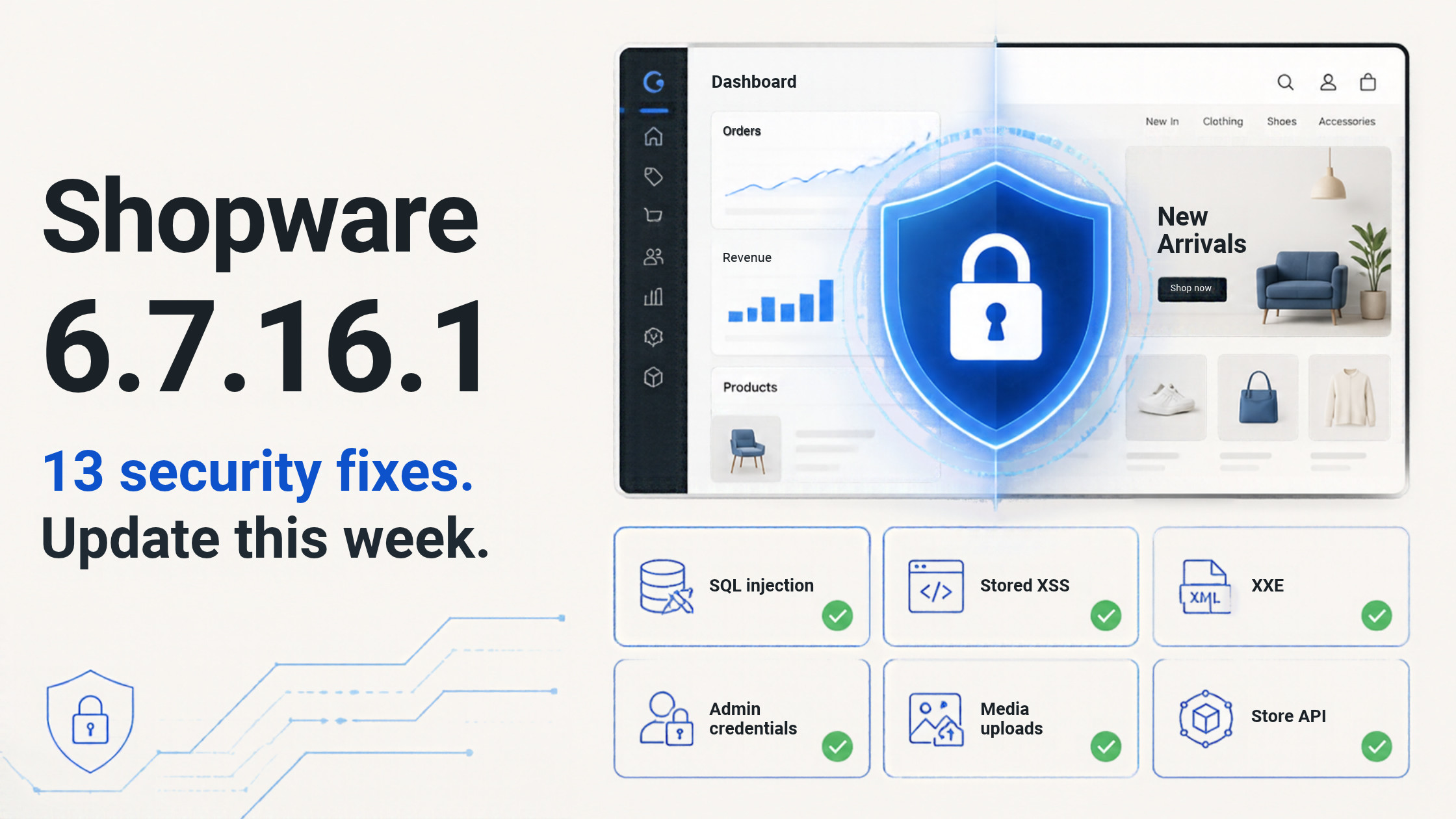
Shopware released version 6.7.16.1 on November 18, 2026. It is a patch release with security fixes, and the release notes tell merchants to update as soon as possible. The release closes 9 issues and lists 13 GitHub security advisories. For stores that cannot update right away, Shopware recommends installing the Shopware 6.7 Security Plugin from its store.
The fixes reach the older line too. The advisories we read in full list every 6.7 release before 6.7.16.1 as affected, along with 6.6 releases before 6.6.10.32, which is the patched version for 6.6. If your store runs either line and nobody has updated it since mid-November, it needs this patch.
Which advisories matter most for a typical store
Thirteen advisories do not carry equal weight. Shopware’s advisory list on GitHub rates three of them Critical, and two of those need no login, only a sales-channel access key.
The SQL injection on PHP 8.2 and 8.3 advisory has a CVSS score of 9.8. It describes an attacker with a sales-channel access key running SQL against the shop database when PHP 8.2 or 8.3 runs with PDO emulated prepares enabled. Storefront clients normally have that key, so treat it as public. According to the advisory, the attacker could read or change records, including customer data and admin credentials.
The Store API aggregation validation bypass (CVSS 9.1) uses the same key to get around field-access rules and read protected fields, including sensitive account information. Headless storefronts give that key to their clients by design, so we would treat this one as urgent on any headless build.
The third Critical item, installed Apps can obtain Administration user credentials (CVSS 9.6), matters to any store with apps in the admin. An active app with Administration content could read the current user’s access and refresh tokens, and the read-based variant needs only an entity read permission such as product:read. If that user is an administrator, the tokens give full admin access. Two High advisories sit next to it: integrations could perform unauthorized user operations, and weak authorization allowed management of admin accounts.
Media is the other area to watch. The stored cross-site scripting through public media advisory (Moderate, 5.7) says a user, integration or app with media:create or media:update permission could store content that runs in another user’s browser. The release also fixes missing authorization for media uploads and media validation that allowed unauthorized file operations. The remaining advisories cover XML external entity injection in extension processing, App package validation that allowed server file disclosure, Twig template isolation, clone validation and API access control.
How to update to 6.7.16.1 this week
For most stores this is a routine patch update, and the release notes link to Shopware’s update guide. We would work in this order:
- Back up the database and files, and write down which apps, plugins and integrations are active.
- Apply 6.7.16.1 on a staging copy and test checkout, customer login and the product screens in the admin.
- Run one full cycle of any ERP, PIM or marketplace sync that writes through the Admin API, since several fixes change what integrations may do.
- Deploy to production in a quiet hour and watch the error log for the rest of the day.
Shopware lists the release as tested on PHP 8.2, 8.4 and 8.5 with MySQL 8, MySQL 9.7, MariaDB 11 and MariaDB 12. If a custom plugin blocks the core update, install the Security Plugin today and schedule the update properly. Teams that manage Shopware with Composer also get a fix for installs and updates that were failing on a low-severity mcp/sdk advisory.
Where neither route is possible straight away, the advisories list stopgaps. The SQL injection and Store API advisories both suggest restricting client-controlled Store API aggregations at the application or reverse-proxy layer. The SQL injection advisory also suggests running PHP 8.4 or later where your Shopware release supports it.
What to check after the update
The release moves the MCP SDK to 0.9 and the MCP bundle to 0.15 to close an advisory, and it tightens origin checks on the MCP endpoint. If anyone on your team connects a browser-based MCP client from an origin other than the shop’s own, that origin now needs an entry in the new shopware.mcp.allowed_origins option. Add it as part of the deployment so the AI tooling keeps working.
Next, look at apps and integrations. If you suspect one misused these gaps before you patched, the app credentials advisory says to revoke affected user sessions and tokens and review administrative activity since then. It also lists deactivating untrusted apps with Administration content as a workaround. On a typical store we would list every app and integration, remove any that nobody owns, and cut each integration’s permissions down to the job it does. An ERP order export rarely needs to manage admin users.
Then open the media folder. The cross-site scripting advisory suggests disabling public HTML uploads, reviewing existing public media and limiting upload permissions to fully trusted callers. Look for HTML or other active files that nobody remembers uploading, and check which integrations hold media:create today.
If your Shopware store exchanges orders, stock or prices with an ERP and you want help testing the patch against that sync on staging, our team can take a look.